
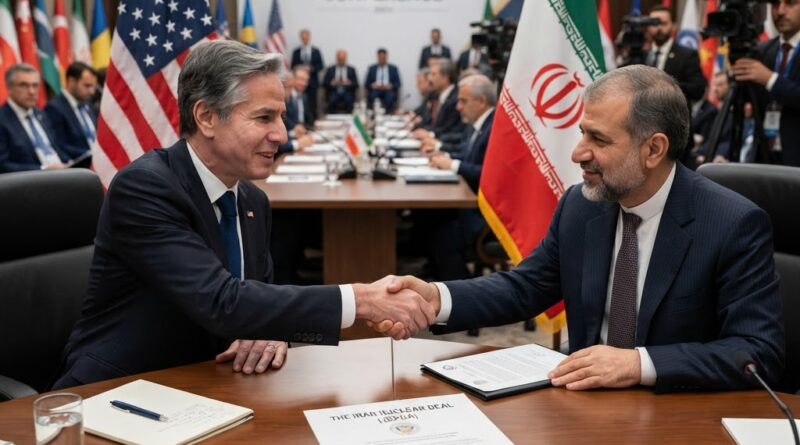
Pakistan Facilitates Dialogue on U.S.-Iran Agreement Amidst Competing Demands
In recent developments, Pakistan has emerged as a crucial player in the ongoing negotiations between the United States and Iran, signaling potential progress toward a diplomatic resolution. However, the contrasting demands from both Washington and Tehran illustrate the significant gaps that still exist in their discussions. Despite their willingness to consider de-escalating regional tensions, the two nations remain entrenched in their respective positions.
The ongoing talks between the U.S. and Iran have been marked by a complex interplay of diplomacy, historical grievances, and geopolitical interests. As both nations express a desire to reduce hostilities in the region, the stark differences in their reparative demands highlight the challenges that lie ahead. Washington is pushing for concessions that align with its broader strategic interests, while Tehran is adamant about seeking reparations for historical grievances it believes the U.S. has inflicted upon it.
Recent reports indicate that Pakistan has offered its support as a mediator, leveraging its unique position and relationships within the region. As a nation that maintains diplomatic ties with both the U.S. and Iran, Pakistan’s involvement could prove beneficial in bridging the divide between the two adversaries. This initiative comes at a time when the international community is increasingly focused on finding solutions to longstanding conflicts that have destabilized the Middle East.
The U.S. has been vocal about its expectations, emphasizing the need for Iran to make significant concessions before any formal agreement can be reached. Washington’s demands revolve around Iran curbing its nuclear ambitions and halting its support for proxy groups across the region. The U.S. believes that these steps are essential for ensuring long-term stability and security in the Middle East.
Conversely, Iran has positioned itself to counter these demands with its own set of reparations, asserting that the decades of sanctions and military actions led by the U.S. have caused considerable harm to its economy and society. Iranian officials have expressed that any agreement must include acknowledgment of these past grievances and provide a framework for reparative measures. This insistence on reparations underscores Tehran’s approach to negotiations, which is heavily influenced by its historical narrative and national pride.
The contrasting narratives presented by both sides illustrate the complexities of the negotiations. While there is a mutual acknowledgment of the need to de-escalate regional tensions, the pathways to achieving this goal remain fraught with obstacles. The U.S. and Iran have been embroiled in a contentious relationship for decades, marked by a series of confrontations and misunderstandings that have fueled mistrust and animosity.
In light of these challenges, the role of Pakistan as a facilitator becomes even more critical. The country’s diplomatic efforts could pave the way for a more constructive dialogue, potentially leading to a framework that accommodates the interests of both parties. As a nation that has historically played a mediating role in regional conflicts, Pakistan’s involvement may help to foster an environment conducive to compromise and negotiation.
While both the U.S. and Iran have expressed a willingness to engage in dialogue, the effectiveness of these discussions will depend on their ability to navigate the complex web of demands and expectations. Analysts suggest that finding common ground will require a shift in perspective from both sides, focusing on mutual interests rather than entrenched positions.
The situation remains fluid, and the coming weeks will be pivotal in determining whether these negotiations can yield tangible results. The international community is closely monitoring the developments, as a successful agreement could have far-reaching implications for regional stability and global security.
As the dialogue continues, it is imperative for both Washington and Tehran to approach the negotiations with a mindset geared towards collaboration rather than confrontation. The stakes are high, and the potential for a breakthrough exists, but it will require flexibility, understanding, and a commitment to addressing the underlying issues that have fueled animosity for so long.
In conclusion, while the road to an agreement between the U.S. and Iran is fraught with challenges, the involvement of mediators like Pakistan offers a glimmer of hope. As discussions progress, the world will be watching closely, hopeful for a resolution that can lead to lasting peace and security in a region that has seen its share of turmoil.
“`